
Core Issues
What's at Stake
PACCOA is actively monitoring and opposing high-intensity digital and industrial infrastructure that threatens community autonomy, environmental integrity, and long-term livability. Below are the critical issues at the forefront of our advocacy work.
Why We're Mobilizing
Because Paulding's Future Should Be Shaped by Its People
Paulding County is at a crossroads. High-intensity technology and infrastructure facilities — including large-scale data centers and surveillance-enabling technologies — are advancing faster than the community's ability to evaluate their long-term consequences. The recent Unified Development Ordinance (UDO) amendment created the Technology Park Overlay District, opening over 1300 acres to land-intensive technology and industrial sites without the human-centered protections residents deserve.
We are mobilizing to ensure that Paulding County's future remains guided by its people: protecting our land, our water, our privacy, our autonomy, and the character of the place we call home. Through organized civic action, public engagement, and community-driven advocacy, we work to overturn harmful zoning decisions and establish responsible, human-friendly standards for all high-impact land-use technology facilities.
Technology Park Overlay District
The TPOD: What It Means for Paulding County
The 2025 Unified Development Ordinance (UDO) amendment created a new zoning category called the Technology Park Overlay District (TPOD) — a 1,314-acre industrial zone designed specifically to allow large-scale data centers and related high-intensity digital and industrial infrastructure.
Under this amendment, high-impact land-use technology facilities can now be built on parcels 50 acres or larger, with permitted uses including battery manufacturing, computing infrastructure, data hosting, telecommunications, scientific research, and other industrial-scale technology operations. The TPOD establishes rules for noise, lighting, buffers, water usage, electric supply, and site design — but these standards were written for compatibility with large-scale digital and industrial complexes, not for the protection of nearby residents, natural resources, or long-term community livability.
PACCOA's Concern
The TPOD was established without proper public notice — denying residents the opportunity to meaningfully participate in a zoning decision that has opened the door to large-scale digital and industrial complexes across hundreds of acres of our community.
The first four proposed high-intensity technology and infrastructure facilities — Taylor Road/Project Sweetwater, Tidwell, Electric Dam, and Cole Lake — fall within the boundaries of the TPOD. The fifth, Switch KEEP 2.0, is currently underway and represents an even larger footprint of mass-scale data and technology installations extending into northern Paulding County and the City of Cartersville.
PACCOA is demanding full transparency about how the TPOD was created, who was involved, and what protections — if any — exist for residents whose neighborhoods, water sources, and quality of life now fall within its boundaries.
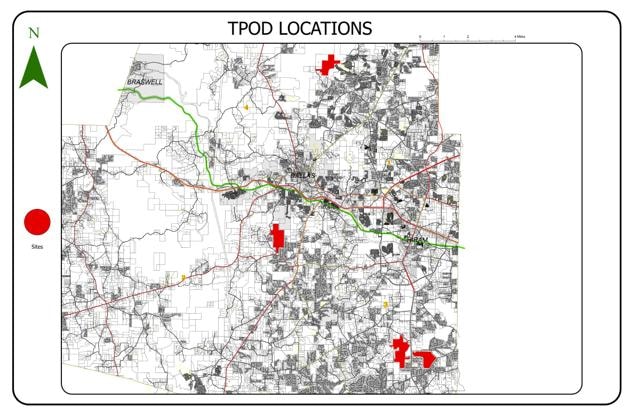
Proposed Sites & TPOD Status
- Taylor Road / Project Sweetwater485 acresWithin TPOD
- Tidwell284.96 acresWithin TPOD
- Electric Dam224.05 acresWithin TPOD
- Cole Lake318.93 acresWithin TPOD
- Switch KEEP 2.02,300+ acresCurrently underway
Key Requirements in the TPOD
From the UDO text:
- Data centers may include "computers and data center equipment, data storage and hosting technologies, and other new technologies" (UDO §220-40.01).
- Parcels must be 50 acres or more (UDO §220-40.04).
- Noise limits allow 65 dBA daytime and 55 dBA nighttime at property boundaries (UDO §220-40.12).
- A 100-foot buffer is required only where TPOD land touches residential property (UDO §220-40.06).
- Mechanical equipment must be screened but may include large-scale generators, cooling towers, and substations (UDO §220-40.07).
- Generator testing is allowed 2 hours per day, Monday–Friday (UDO §220-40.12).
- Developers must show water and electric capacity before approval (UDO §220-40.13–14).
- TPOD projects are exempt from Corridor Overlay standards if not visible from major roads (UDO §220-40.15).
These standards were not designed with community autonomy, environmental integrity, or long-term livability in mind. They were designed to enable high-demand digital and utility infrastructure at industrial scale.
Why This Matters
The TPOD opens the door to high-intensity technology and infrastructure facilities — including industrial-grade computing and surveillance infrastructure — in Paulding County, without the community-driven protections that residents deserve. And because the TPOD is already codified into the UDO, these high-resource industrial technology zones can advance quickly unless residents actively participate in the civic process.
Without appropriate constraints, data centers can create:
Why Community Involvement Is Essential
The TPOD amendment can be changed or overturned through public pressure, organized civic action, and direct engagement with county leadership.
These protections will not appear on their own. They must be advocated for, organized around, and insisted upon by residents.
PACCOA believes Paulding County deserves human-friendly standards for all high-impact land-use technology facilities, including:
- Independent impact analyses across the full spectrum of environmental, social, and civil liberties consequences
- Robust environmental protections with binding, enforceable standards
- Strict noise ceilings and generator emission limits
- Water-use caps, consumption reporting, and discharge quality criteria
- Mandatory facility purpose disclosure, use restrictions, and periodic audit requirements
- Expanded setback and buffer requirements to protect adjacent residents and ecosystems
- Enforceable protections for endangered and at-risk species on and near proposed sites
- Fully transparent, publicly noticed approval processes with meaningful community input
- Community-driven land-use planning that prioritizes residents over industrial interests
- Firm limits on the scale and density of industrial digital infrastructure
- Ongoing oversight, compliance monitoring, and clear accountability mechanisms
Proposed Projects
Known Data Center Proposals
The following large-scale digital and industrial complexes have been identified through public records, planning documents, and community reporting.
Taylor Road / Project Sweetwater
Taylor Road corridor, Paulding County
One of the largest proposed mass-scale data and technology installations in the county, Project Sweetwater encompasses approximately 485 acres along the Taylor Road corridor. The scale of this high-demand digital and utility infrastructure raises serious concerns about land use, stormwater runoff, traffic, noise, and the long-term character of the surrounding community.
At-Risk Species in This Area
Tidwell
Paulding County
The Tidwell site spans nearly 285 acres and represents a significant high-resource industrial technology zone in an area that residents value for its rural and residential character. PACCOA is tracking this proposal and engaging with county officials to ensure community concerns are heard.
At-Risk Species in This Area
Electric Dam
Paulding County
The Electric Dam proposal covers over 224 acres of ecologically burdensome digital infrastructure situated in proximity to sensitive environmental areas. PACCOA is concerned about the potential impacts on local waterways, wildlife habitat, and the quality of life of nearby residents.
At-Risk Species in This Area
Cole Lake
Paulding County
The Cole Lake site encompasses nearly 319 acres of proposed high-intensity technology and infrastructure facilities. Given its proximity to water resources, this proposal raises particular concerns about water consumption, thermal discharge, and the protection of the natural environment that defines this part of the county.
At-Risk Species in This Area
Switch KEEP 2.0
City of Cartersville and northern Paulding County
By far the largest proposal in the region, Switch KEEP 2.0 spans more than 2,300 acres of large-scale compute and utility development across the City of Cartersville and northern Paulding County. This project is already underway — which makes accountability more critical than ever. Elected officials must be held responsible for any violations of environmental, zoning, or public health standards. Independent auditing of construction and operational progress is essential to ensure commitments made to the public are actually kept. Every resident within a 3-mile radius should document their current water quality, utility bills, and ambient noise levels now — this baseline data could prove invaluable in any future legal action. PACCOA will continue coordinating with partner organizations to monitor this development and ensure the community has the information and tools it needs to protect itself. And Switch is continuing to buy land inside Paulding.
At-Risk Species in This Area
Combined Footprint
3,612+ acres
The five known proposals together represent over 3,600 acres of Paulding County and surrounding land targeted for industrial data center development.
Mass Warrantless Surveillance
Industrial-Grade Surveillance Infrastructure
Data Centers and End-Users
A data center's business model depends on providing highly reliable, uninterrupted service to the companies and organizations that rely on its infrastructure. Any disruption caused by local opposition, regulatory disputes, litigation, permitting conflicts, construction delays, environmental violations, utility constraints, or other community-related issues can create significant costs for both the data center operator and its customers. Any hinderance, or even simple uncertainty, can lead customers to seek alternative facilities, and reduce or sever their commitments. In turn, this can damage the data center's ability to secure the committed customers they require to build and operate. PACCOA recognizes the need for pursuit of this angle in our fight against data centers.
End-Users as Threats to Civil Liberties
Data centers are not passive storage facilities. Many of the large-scale digital and industrial complexes proposed for Paulding County are designed to host, process, and distribute surveillance-enabling technologies — including facial recognition systems, license plate readers, predictive policing platforms, and mass data aggregation services.
Flock Safety license plate readers have already been deployed across Paulding County — capturing the movements of residents without their knowledge or consent, and without any meaningful public debate. PACCOA is committed to the removal of these mass warrantless surveillance systems from our community. No government or corporate entity should have the ability to track where residents go, when they travel, and who they associate with — simply by driving on a public road.
When industrial-grade computing and surveillance infrastructure is built in a community without public consent or oversight, it creates the physical and technical foundation for monitoring residents at scale. These facilities are not being built to improve modern life or deliver new conveniences to residents — they are being built to expand a digital control grid that serves corporate and government interests, not the people who live here. PACCOA believes that no large-scale compute and utility development should be permitted to operate in Paulding County without clear, enforceable protections for civil liberties, personal privacy, and community autonomy.
Key Privacy & Civil Liberties Concerns
Mass Data Collection
High-demand digital and utility infrastructure built at this scale can support the collection and processing of vast amounts of personal data — including location history, communications metadata, financial activity, and biometric information — without residents' knowledge or consent.
Facial Recognition & Biometrics
Large-scale compute and utility developments increasingly host AI-driven facial recognition and biometric identification systems. These technologies, when deployed without oversight, erode the presumption of anonymity in public life and disproportionately harm vulnerable communities.
Government & Corporate Surveillance
Mass-scale data and technology installations can serve as infrastructure for both government surveillance programs and corporate data brokers. Residents have a right to know what entities are operating in their community and what data is being collected about them.
No Community Consent
The TPOD was created without public notice or community input. Residents were never asked whether they consented to hosting high-intensity technology and infrastructure facilities that may enable surveillance at scale. That absence of consent is itself a civil liberties issue.
Lack of Legal Protections
Paulding County currently has no ordinances specifically addressing the civil liberties implications of ecologically burdensome digital infrastructure. PACCOA is advocating for enforceable privacy protections as a prerequisite for any approval of high-impact land-use technology facilities.
Chilling Effects on Free Expression
When residents know — or suspect — that their movements, communications, and associations are being monitored by industrial-grade computing and surveillance infrastructure, it suppresses free speech, assembly, and civic participation. A community under surveillance is not a free community.
PACCOA demands that any proposed high-resource industrial technology zone in Paulding County be subject to a full civil liberties impact assessment — conducted publicly, with community participation — before any approval is granted.
Why It Matters
Community Concerns
Environmental Impact
Ecologically burdensome digital infrastructure consumes massive amounts of water for cooling and generates significant stormwater runoff. These projects threaten local waterways, wetlands, and the natural environment that Paulding County residents cherish.
Power Grid Strain
High-demand digital and utility infrastructure places enormous demands on the electrical grid, potentially driving up energy costs for residents and businesses while straining infrastructure that serves the entire community.
Land Use & Character
These proposals would convert thousands of acres of rural and semi-rural land to land-intensive technology and industrial sites, permanently altering the character of our community and reducing green space and agricultural land.
Noise & Light Pollution
High-intensity technology and infrastructure facilities operate 24 hours a day, generating continuous noise from cooling systems and significant light pollution that affects the quality of life for surrounding residents.
Transparency & Accountability
Many of these large-scale compute and utility developments have advanced with limited public notice or community input. PACCOA demands full transparency from both developers and county officials throughout the planning and approval process.
Economic Trade-offs
While proponents cite tax revenue and jobs, residents deserve a full accounting of the costs — infrastructure upgrades, environmental remediation, impacts on property values, and the long-term burden on public services imposed by industrial-grade computing and surveillance infrastructure.
Resources
Policy documents, research, and reference materials to help residents understand the issues and engage effectively.
Finally — A USA Data Center Placement Control Layer
By Garlando McCord Sr.
A comprehensive policy framework proposing a national control layer to govern where large-scale data centers can be sited in the United States. This document provides critical context for understanding the regulatory gaps that allow industrial-grade computing infrastructure to be placed in communities without adequate oversight, environmental review, or civil liberties protections.
Stay Informed. Stay Engaged.
PACCOA will continue to monitor these high-intensity digital and industrial infrastructure proposals and keep residents informed. Sign up to volunteer, attend public meetings, and make your voice heard.